Greetings Travelers,
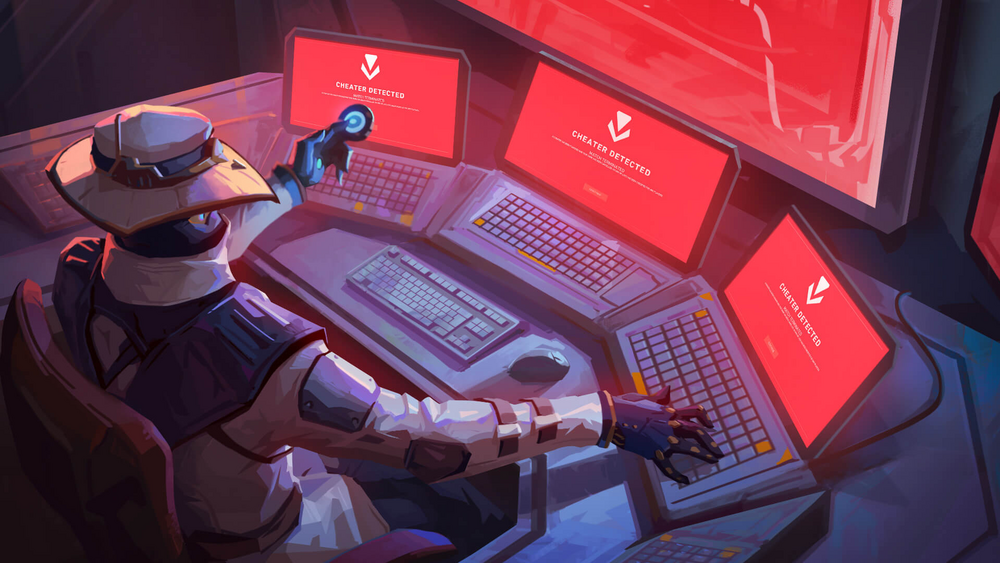
Fortune must favor us, because by sheer popular demand, 2026 has brought not one, but two back-to-back anti-cheat updates. Like always, the human before you at this typewriter (candlelit and in the rain) will be Phillip “mirageofpenguins” Koskinas, science’s first attempt at creating a man that can convert bans into energy, but unlike always, this article will not focus on the prototypical “cheater.”
Instead, we’re going to talk about our fight against Rank Manipulation in League of Legends and VALORANT, or more specifically, the detection systems we’ve been hammering into place to help boosters relocate to their own accounts and stay there. As easy as that might sound, it’s hard for some cheaters to consistently play against opponents of their own skill level, and that’s exactly why we’re so keen to assist them using Vanguard’s “Anti-Boost” technology.
Vanguard Anti-Boost
First privately launched on League of Legends in September 2025 and wielded most effectively by the inestimable Drew Levin, Vanguard’s Anti-Boost system is a classification layer that simply detects when a significant amount of an account’s ranked points (“boostee”) are obtained by another, higher-rated player (“booster”) logging into it, performing well beyond the usual inhabitant’s skill level and often queuing with other, lower-rated players (“hitchhikers”) to bring them along for the ride to Challenger. After almost a year of beta testing on League, VALORANT has also now adopted the system, increasing its power two-fold.
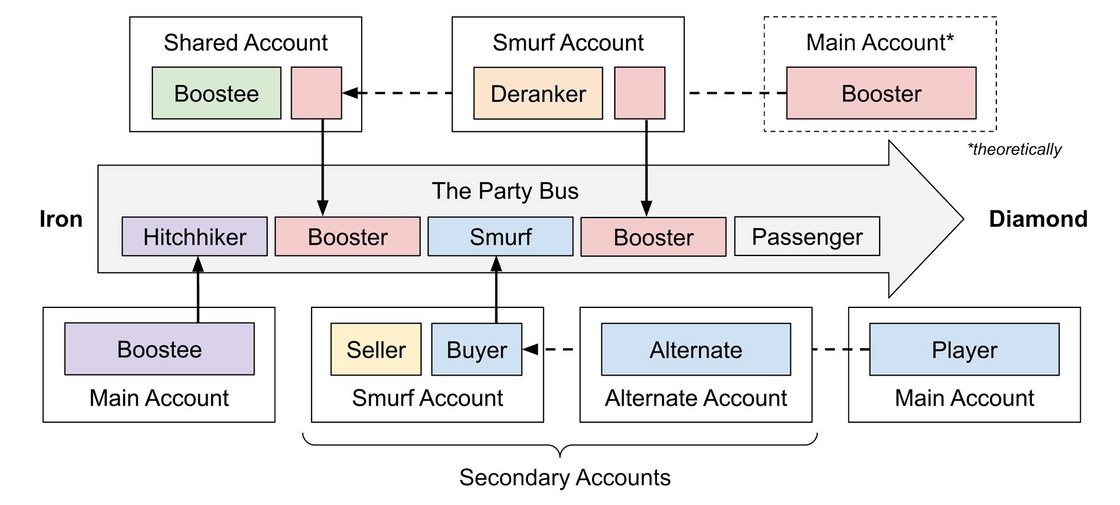
When a player logs into an account they’re not the true owner of, they temporarily blind the game’s matchmaking algorithm to their real rating and find themselves placed into matches with less experienced competition. Now, while there are a wide variety of reasons one might wish to do that (most of them not very good), the end result is obvious to any modern machine classifier: an account vanishes from one location, appears in another location, and then starts beating the complete daylights out of their opponents, a lot like a 30-year-old adult man in a game of T-Ball. Sure, my guy might be absolutely crushing homers, but if you listen closely, you’ll notice that none of the moms are cheering, including his.
So, when Vanguard detects that an account has obtained its rating this way, we take a few actions.
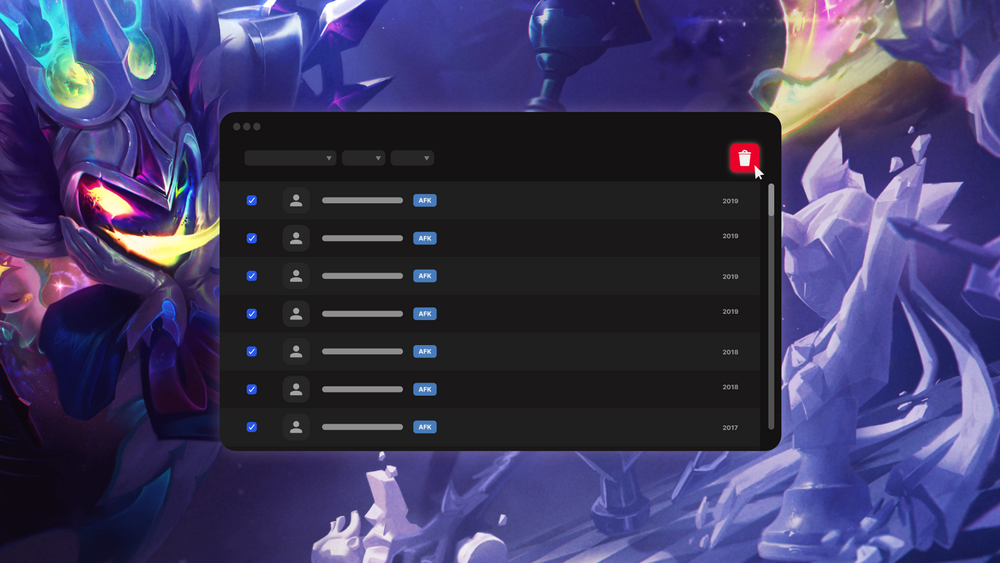
First, the ranked points or ranked rewards that were gained by the “booster” are revoked, returning the “boosted” account to its original rating and temporarily suspending it, with increasing duration for each offense (from three days, all the way up to three centuries).
If the offending account was purchased or had no real owner (“smurf”), we instead ban it for one eternity, because “deranked” accounts have literally no value to the competitive ecosystem.
Secondly, if this behavior is a developing habit of a known “booster,” and if that booster has a “main” account, then we also levy escalating suspensions upon it, in the hope that they consider an alternative hobby, like phillumeny or maybe zumba.
Finally, any “hitchhikers” that repeatedly partied with smurfs or boosters receive the same treatment, losing the undeserved rank even if obtained unknowingly (which is very unlikely, let’s be real), because you don’t get to keep the medal when one of the relay legs was run by a dude with 30% more blood than he’s supposed to have.
Since late last year, we have actioned exactly 296,416 accounts for rank manipulation across both VALORANT or League of Legends, and we aren’t even yet at full power. As we crank the voltage on rank removal in the coming months, it is our intent that all players be encouraged to utilize the time-honored tradition of getting good as their preferred way to rank up, so the easiest way to avoid these suspensions is very simple: play ranked on your own accounts, partied only with other players who are also on their own accounts.
But Why?
Well for starters, we don’t want the time any player puts into the game to lose its inherent value or feel wasted. Here at Riot, we like our tea black and our games fair. The best sports are sticky precisely because they have steep difficulty curves, and hard-earned mastery should never be cheapened by seeing wins offered for sale. As a game studio, we typically prefer when players want to keep playing, and the best way for them to do that is if the rewards are actually rewarding.
But for finishers, it’s also because secondary accounts were getting a little out of hand.
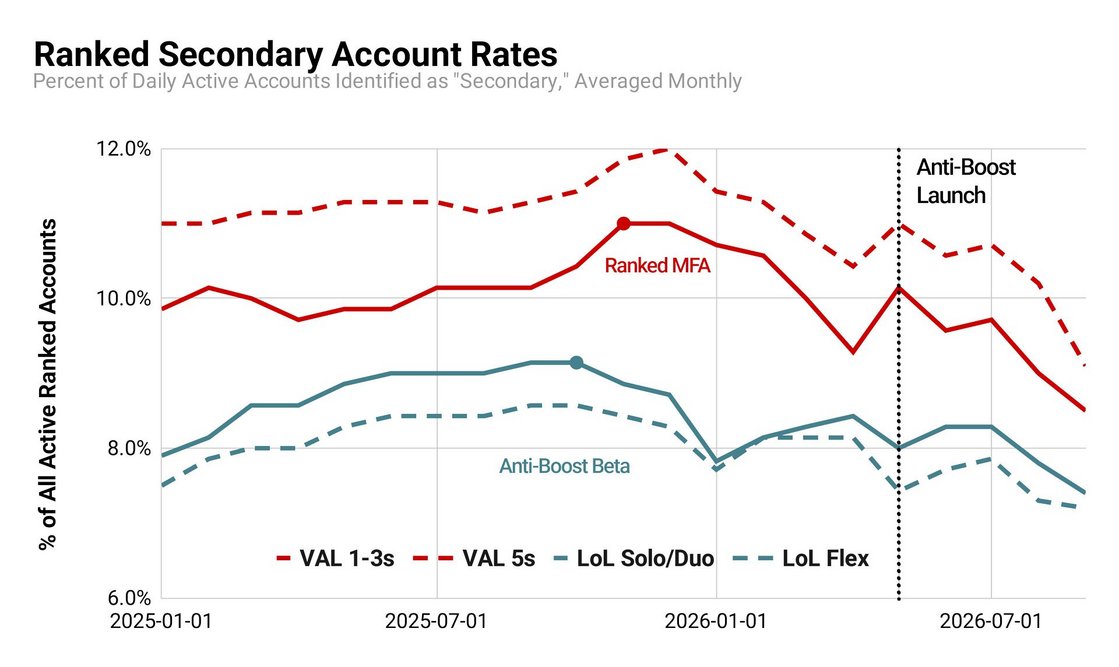
The graph above is the percentage of daily active ranked accounts on both League or VALORANT where the piloting player was technically not on their “main,” and yes, you are reading that correctly: around ~9% of daily accounts utilized in Ranked are considered secondary, this figure also including those that were shared or stolen by another player on that particular day. Annotated here, you’ll see a few key dates: (1) the date Anti-Boost went live on each game, and (2) the date VALORANT shipped Ranked MFA requirements for unowned or shared accounts.
Anyways, before the rollout of Anti-Boost, the secondary-account rate was slowly increasing, in some part because smurfing itself is just a race to the bottom. As matches feel less and less fair, more and more players are incentivized to buy accounts or buy boosts to even the odds, resulting in a trend that statisticians refer to as a “Bad Line.” But because it’s better for both matchmaking and for new players if everyone plays on their mains, this was a slope we wanted to multiply by -1 (or even -2, technology permitting).
Just Ban Them All
Okay, I love the energy and the hustle, but as it turns out, not all secondary accounts are created equal. Around 50% are mostly harmless, and simply deleting all of them would not be good for the game (or for player support ticket queues).
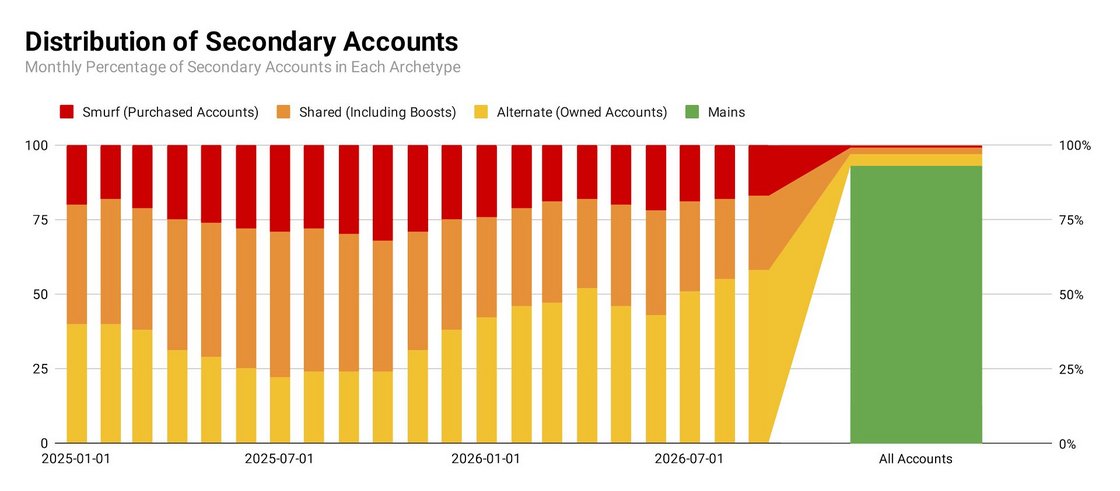
Here, you can see a distribution of secondary account varietals over time, and what might hopefully become evident by allowing photons to bounce off of it and into your retinas is that Anti-Boost is deliberately not targeting unshared, “alternate” accounts (yellow). Instead, we are targeting account purchases (“smurfs” in red) or account sharing (“boostees” in orange), as the primary means through which rank is stolen. And there are several good reasons for that.
Benevolent Alternates
Personally, like many great philosophers before me, I’m a one-account maximalist. I believe the best competitive experiences are born from tournaments where all combatants have equal footing and one identity that we cheer for in a league they’ve earned their place in. No matter how you slice it, when a player jumps onto an alternate account, they’re lowering the stakes.
“Bro, stop hiding your regalia to power farm noobs, it’s embarrassing.”
- Socrates, 449 BCE
So, what makes the problem harder to solve, is that not every account is created with the intention of circumventing matchmaking or bypassing a ban, and while we do still want to get everyone onto a single account (eventually), outright punishment is not the answer to a few of these player needs, specifically:
Practicing new strategies or new Champions/Agents in a competitive setting
Protecting the current Personal Best of your main’s rank, but still getting practice reps in on an account of similar standing
“Team” accounts for practicing as a continuous, tight group of five
Better anonymity, especially for public figures that are frequently the target of in-game trolling
“One Trick” accounts that hyper-focus on a particular strategy or role in earnest (the siren call of AP Graves)
Grinding out a high-rank twice, as insane as that would sound to anyone that’s played ranked even once
Leading a double life where you affect an obviously fake British accent on comms and go by the name “Barnaby”
So, if you created the account, you leveled it yourself, and you never share it, we consider it a clean, free-range, non-GMO, “alternate” account. As long as you don’t abuse alternate accounts to party bus other players to higher ranks (“hitchhiking”), it is ultimately the game’s responsibility to place you accurately. A good rule of thumb here is to rank your alternate up before you start queuing with your friends, or you’ll risk having their undeserved rank removed.
Malevolent Smurfs
The remaining reasons for secondary accounts are decidedly NOT clean, and we are officially declaring open season on purchased smurfs or shared accounts, especially when they are used to engage in ranked manipulation. The primary vehicle through which rank is stolen is account sharing, be it directly with a booster or indirectly as their hitchhiker, because a constant influx of lower-rated accounts are the fuel that boosters crave.
While we’d much rather just ban them at the soul-level, that’s just not viable. Like our old friends—the cheaters—boosters also long ago accepted that they are not interested in playing fair, and many of them would also cheat on their customer’s accounts, if that wouldn’t result in the customer being banned and a paypal dispute being filed. Some boosters have no “main” to suspend, because the way they engage with the game is on accounts they do not own, on hardware they’re quick to refurbish (just like a cheater).
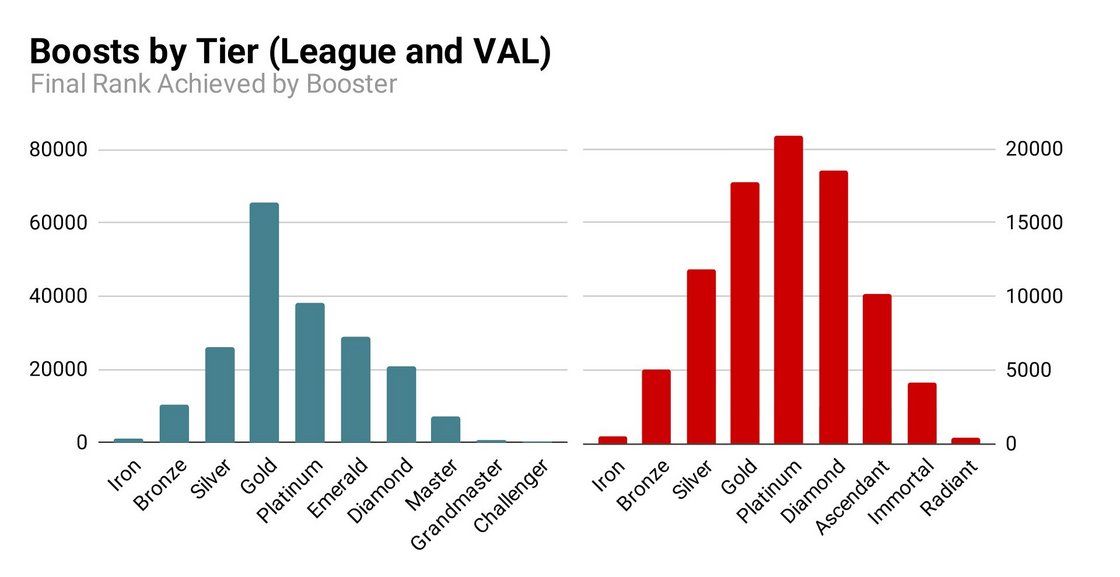
Ultimately, we have to hold accounts responsible for the actions taken on them, so for the avoidance of doubt, below is a non-exhaustive list of behaviors that will get your account suspended and its rank removed.
Sharing your account with a boosting service to rank up for you
Paying boosters to queue with you on smurfs, even if you’re playing on your own account
Giving your higher-rated friend a lower-rated account to queue with you on
Buying or borrowing a low-rated account to record frag footage for social media
Deliberately losing to derank an account, especially if you also use that account to boost another player
Bypassing chat bans on your main account by buying a new one when going outside is free
Ranking up your friends by queuing with them on accounts you don’t actually own
5-stacking with four other smurfs while you are also yourself smurfing and advertising your account-selling services in all-chat
Now, I get it. Some of these, especially that last one, can be difficult to avoid. However, thanks to the invisible hand of microeconomics, we know that by increasing the difficulty of operating boosting and smurfing products, we can drive down customer demand, reducing the viability for these things as a business and increasing match quality over time. Because when spare accounts cost more, the time spent on your own account is worth more. Q.E.D.
For the record, you can also read more about each individual game’s punishment strategies below:
Match Quality
Our last graph of the evening will be the most interesting, and you have the eight teenage weeks I spent at math camp to thank for that. The lines below, graphed on the left Y-axis, are the average of how many standard deviations away every player is from their highest account’s Matchmaking Rating at the time of each match. So, if a player is playing on their highest account (or on a similarly rated account), then their contributing score here would effectively be zero (or close to it). I’ll admit, even re-reading that explanation is hard, so let’s just think of these red and blue lines as a dirty estimator for match fairness.
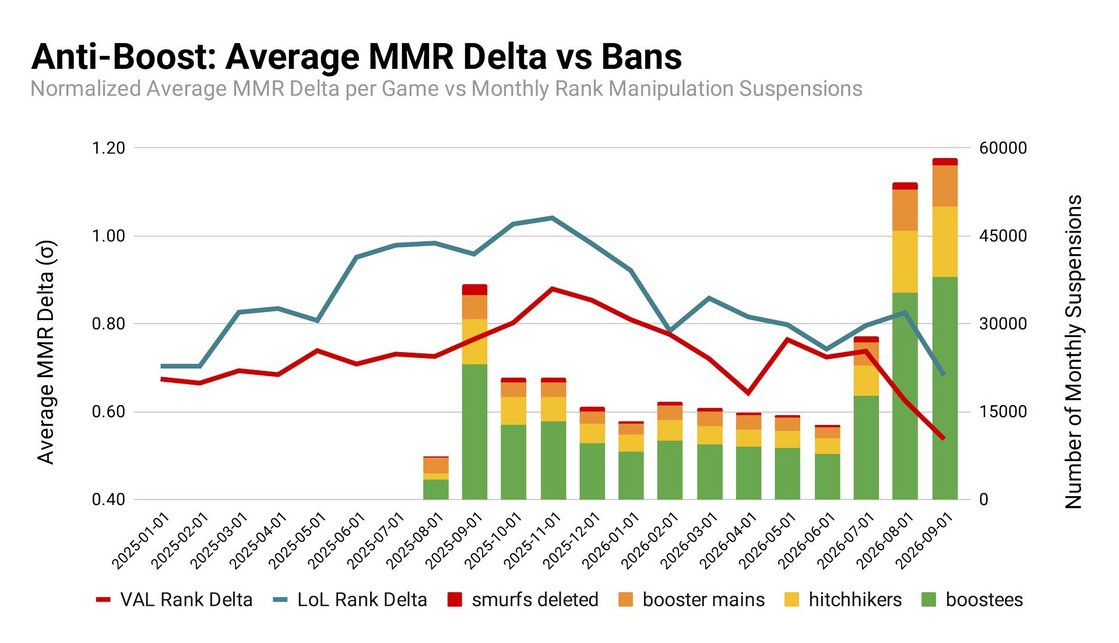
And the bars graphed on the right axis are glorious, uncompromising justice, rendered here in 2D format based on what behavior the offending account was engaged in prior to its suspension. So, the good news is that Anti-Boost actually works. We’ve successfully reverted what would’ve otherwise been a worrying trend, and while boosting services are unlikely to just give up, at least their addressable market is shrinking.
But the tougher news is that bans alone can’t get us to the point where matches are as perfectly fair as we need them to be, and in a reality where a new account is just a prompt away, it isn’t enough for us to be exclusively reactive.
Future
To prevent what would otherwise see the internet itself slowly descend into a recursive LLM free-for-all, our trust anchors as a community must improve. For competitive games to remain competitive and for human spaces to remain human, we have to increase our pre-emptive “proof of life” posture on the endpoints that connect to our servers. Or more colloquially, we need to know that our game client is on real hardware, piloted by real flesh, connected to actual neurons (and that last one I added for safe measure).
That does ultimately mean that you can anticipate things like MFA restrictions or TPM 2.0 requirements on an expedited timeline, but it also means less bots, better matchmaking, and stickier punishments. By using Vanguard’s hardware attestation, we plan to keep our low(ish)-friction signup without sacrificing match quality or repeatedly re-exposing ourselves to bad actors. Stay tuned for more news on when these requirements will be necessary and at what ranks, but if you were to be so bold as to preempt the requirement, you can actually take advantage of Vanguard Pre-Check right now.
Closing
Alright, it’s finally getting to be about that time, so that’s all for now. In a world where words mean less, it means the world that you skimmed this. Remember that fair play is the best kind of play, and that when you steal from your community, you’re only stealing from yourself. But if that doesn’t work, and you do get banned for boosting, please file a chargeback with your booster for services not rendered—that’s just the free market at work.
Thank you.

Phillip Koskinas
In 1414, Phillip invented cheating. This was later determined to have been a bad move, and he now must work to rid it from this universe or risk being sent back to the pain dimension. When he’s not beaming pasters, Phillip manages Riot’s competitive integrity portfolio, which includes Vanguard, an anti-cheat that has made cheaters experience a variety of emotions.